
Listen to article this article now.
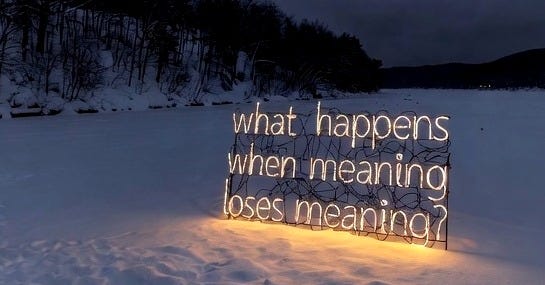
A Word’s Emotional Weight
Within twenty-four hours of Hamas’ October 7, 2023 massacre of approximately 1,200 Israeli civilians—the deadliest single-day killing of Jews since the Holocaust—demonstrators in London, New York, and Sydney were already accusing Israel of committing “genocide.” This happened before the IDF had launched any sustained ground campaign and before any legal body had begun gathering evidence. The accusation’s speed alone isn’t proof of bad faith—moral horror at anticipated civilian casualties can precede deliberation—but it raises a question worth taking seriously: what exactly was the term “genocide” being used to for?
Consider what happened to the word “terrorism.” It began as a descriptor of specific, documented violence—acts designed to intimidate civilian populations for political ends—a term with real legal weight. Decades of overuse changed that. Today it functions in many contexts as a general pejorative for political violence someone finds objectionable, applied to insurgencies, protests, and state actors alike without regard for the legal criteria the term was designed to capture. The accusation has grown louder as the weight of its definition has weakened.
The trajectory of “genocide” in Israel-Palestine discourse follows the same pattern. Linguists call this “semantic pejoration”: when a term is repeated in ideologically charged contexts, its emotional force begins to replace its technical meaning. When “genocide” is applied selectively and repeatedly to a single Jewish political entity, it begins to function like an antisemitic slur.
What Does Genocide Actually Mean?
Raphael Lemkin was a Polish-Jewish lawyer who lost forty-nine members of his family in the Holocaust. He coined “genocide” in 1944 to name a crime for which international law didn’t yet have a term: the deliberate effort to destroy a people as such, rather than as a consequence of armed conflict. The 1948 UN Convention on the Prevention and Punishment of the Crime of Genocide codified this as acts “committed with intent to destroy, in whole or in part, a national, ethnical, racial or religious group.”
The intent requirement—proof that the perpetrator aimed to eliminate a group as such—is what makes genocide different than war crimes, crimes against humanity, and ethnic cleansing. Genocide requires proof that the perpetrator wanted to wipe a people from the earth. You can condemn civilian deaths in Gaza under the laws of war, or a single act of torture, without reaching for the gravest charge in international law.
These categories exist so that accountability can be proportionate and targeted. When they all become “genocide,” the meaning disappears, and with it the ability to assign specific legal responsibility when an actual genocide occurs. An accusation that rests entirely on the gravity of a word rather than on facts is a weak claim, however forceful it sounds.
Think of what happens when someone at work is accused of harassment without documentation, witnesses, or a formal process. If the evidence isn’t there, the charge should be dropped. But when it isn’t—when the accusation circulates anyway—it poisons the environment for everyone. People stop trusting the process. And when the same charge is eventually brought against someone who genuinely committed it, people are already exhausted. The word has been spent.
Something else can happen too: the process itself becomes the problem. When asking for evidence is met with “I shouldn’t have to prove it to you”—or worse, “the fact that you’re asking proves you’re complicit”—the demand for accountability has been flipped into an accusation. The person asking a reasonable question is now the one on trial.
When that response comes from a single person in a heated argument, it’s a bad faith move. When it comes from podiums, UN reports, academic conferences, and NGO campaigns, something more systematic is happening. Scholars of political epistemology call this “collective gaslighting”—when shared standards for testing a claim have been dismantled across institutions.
From Misuse to Slur
Getting “genocide” wrong is not, by itself, antisemitic. States and political actors misuse the term all the time for their own purposes. Russia, for example, invoked the Genocide Convention to describe how Ukraine was treating Russian-speaking populations in the Donbas region, claiming that Ukrainian cultural and language policies amounted to genocide. Genocide scholars rejected this outright, as there was no evidence of eliminationist intent, and the invocation appeared designed to provide legal cover for Russian military aggression. It was a cynical misuse of a serious legal instrument, but it had nothing to do with Jews. Russia was doing what powerful states sometimes do—weaponizing the language of human rights to justify their agenda.
So, what makes the misuse of “genocide” against Israel different?
The difference is that the misuse follows a specific pattern with a recognizable history. Unlike ordinary political hostility, antisemitic delegitimization tends to position Jews as a uniquely malevolent force: people whose actions are cast as threatening to humanity itself, and whose claims to victimhood, safety, or self-defense are treated with suspicion. Whatever Jews say in their own defense becomes further evidence of their guilt. In these accusations, the charge precedes the evidence, which is then constructed to justify it.
The misuse of “genocide” against Israel fits this pattern in three specific ways:
Timing: After October 7, 2023, the accusation of genocide surfaced within twenty-four hours, while Israel was still counting its dead, before IDF operations were underway. Verdict before inquiry.
Selectivity: Between 2016 and 2020, Myanmar’s military conducted operations against the Rohingya that the UN Fact-Finding Mission formally characterized as bearing the hallmarks of genocide. Military commanders had issued explicit dehumanizing statements about the Rohingya as a group—the kind of direct evidence of eliminationist intent that makes a genocide determination legally plausible. That campaign killed an estimated ten to twenty-five thousand people and displaced over 700,000 within weeks. The Tigray conflict (2020–2022) generated even stronger evidentiary claims: casualty estimates ranged from 162,000 to over 500,000, and human rights organizations documented systematic mass killings, forced starvation, and dehumanizing official statements also consistent with eliminationist intent.
In both cases, the sustained institutional pressure directed at Israel—measured in the volume and intensity of UN resolutions, academic conference programming, and NGO litigation campaigns—has been far greater, despite a substantially weaker evidentiary case.
The disparity is visible in UN institutional outputs:
Between 2015 and 2024, the UN General Assembly (UNGA) passed 173 resolutions targeting Israel—more than double the 80 passed against all other countries combined.
In 2024 alone, Israel received 17 UNGA condemnations; Myanmar received one, and Ethiopia received none.
Since the United Nations Human Rights Council’s (UNHRC) founding in 2006, Israel has been the subject of 112 resolutions; Myanmar, 34. The Tigray conflict—which produced casualty estimates in the hundreds of thousands—generated exactly one UNHRC resolution, passed by a vote of 20 to 14.
Myanmar did not receive its first UN Security Council resolution until December 2022, more than a decade after atrocities began.
When a legal standard is applied to one party with an intensity not replicated in cases presenting stronger evidence, the disparity demands explanation; political animus is a plausible one.
Rhetorical pattern: Without evidentiary support, the accusation of “genocide” against the Jewish state often functions as a way of delegitimizing Jewish sovereignty. It draws on a centuries-old pattern that characterizes Jewish conduct as uniquely evil and civilizationally threatening. That pattern has a name—and it is older than the modern state it now targets.
Old Script, New Language
The accusation that Jews commit the worst imaginable crimes against innocents is not new. What changes is the language used to express it. In medieval Europe, it took the form of the blood libel: Jews were said to murder Christian children for ritual purposes. In the early twentieth century, it became the conspiracy of Jewish world domination. Today, in the language of international human rights law, the charge is genocide. While the vocabulary shifts, the structure does not.
In most accusations, evidence precedes the charge. Here, the charge precedes everything—constructed to justify persecution rather than respond to it. The objective remains the same: to strip Jews of legitimacy and justify exclusion or worse. In the case of Israel, the target is political legitimacy—the right to exist as a sovereign state.
The form this takes today—the one most directly driving the genocide accusation against Israel—has a specific name: “Holocaust inversion.” It depicts Jews and Israel as the “new Nazis” and Palestinians as the “new Jews,” using Holocaust language (genocide, ghetto, extermination) to recast Jews as perpetrators of the crimes once committed against them.
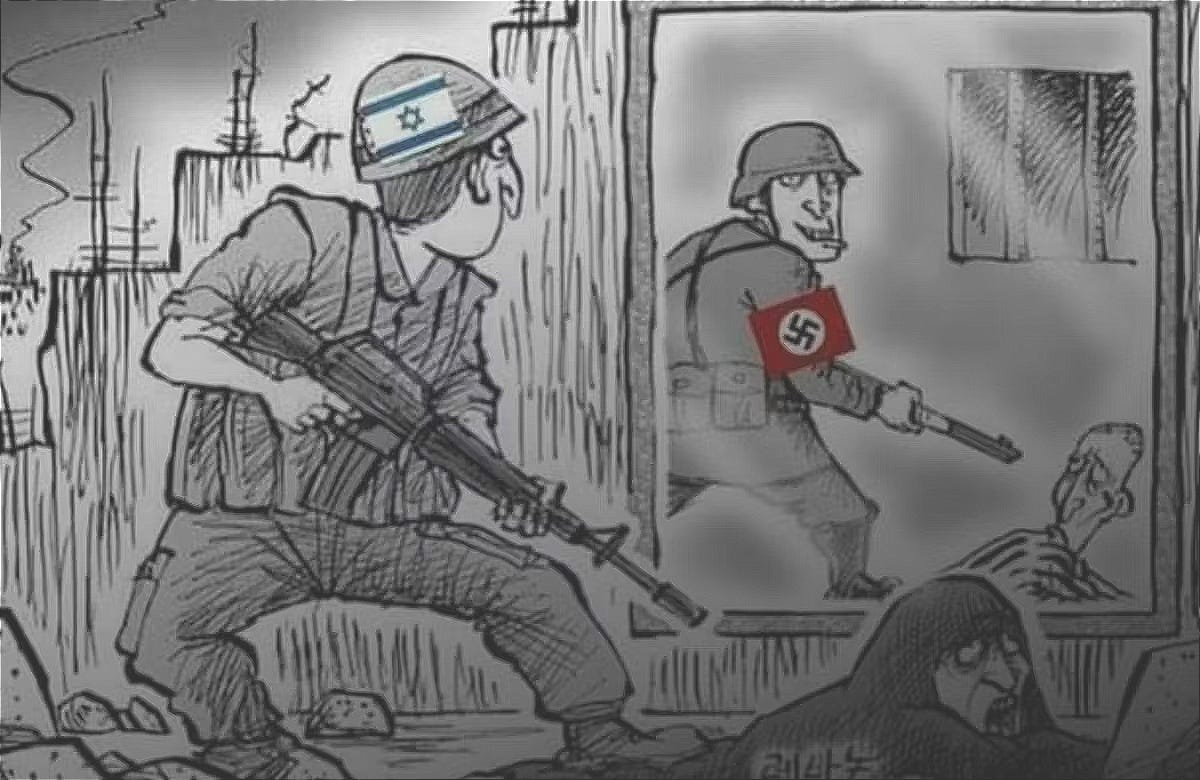
This inversion also explains how the term “genocide” detaches from evidence. Once Israel is positioned as a Nazi analogue, the conclusion is already embedded in the frame, and the accusation follows almost automatically.
The pattern is not new to the post-October 7 moment. As Norman Goda documents, virtually identical accusations—Nazi comparisons, blood libel tropes, charges of Jewish manipulation of Western governments—were leveled at Israel in the UN General Assembly during the 1982 Lebanon War, by states whose own forces had committed mass atrocities they were simultaneously refusing to acknowledge.
For European audiences in particular, inversion serves an additional function. In Germany and Austria, it displaces unresolved guilt about the Shoah onto Israel. In Britain, Ireland, and much of Western Europe, the operative framework is colonial—Israel is conscripted into a postcolonial lens through which these societies process their own imperial histories.
South Africa is the sharpest case: a country whose apartheid past gives the genocide accusation both moral authority and psychological utility, allowing it to position itself as the conscience of the oppressed while deflecting continued scrutiny of its own present failures of governance. After all, it was South Africa that brought forth the International Court of Justice (ICJ) case.
In the United States, the frame shifts again: Israel becomes the stand-in for white settler colonialism, Palestinians for the dispossessed, and the conflict gets absorbed into domestic narratives about race and structural inequality.
In each case, the memory of Jewish victimhood is repurposed into a justification.
How Words Lose Their Meaning
When a technical term moves from a professional setting—where clear criteria govern its use—into political discourse, it often stops functioning the same way. “Genocide” is a case in point.
In law, the term has a specific threshold, including the requirement to demonstrate intent. In activist contexts, it is increasingly used as a general marker of moral condemnation. This is more than semantic drift, as the two usages now compete.
When a legal scholar argues that the available evidence does not meet the Convention’s threshold for genocide, the response is often a label: apologist, “Zionist” (deployed as a slur), defender of ethnic cleansing. The claim is not refuted; the speaker is disqualified. Once that happens, the argument no longer needs to be answered.
This is the breakdown of shared standards of evaluation. Credibility is withdrawn based on who the speaker is presumed to be, rather than on the strength of the argument itself. The result is the removal of the conditions under which a disagreement could be meaningfully resolved.
When the Courtroom Joins In
As the meaning of “genocide” shifts in public discourse, it begins to move upward into legal and institutional settings, acquiring the appearance of authority along the way.
Ireland’s submission to the ICJ, urging the court to “broaden” its interpretation of the Convention to include collective punishment, is one example. Such proposals would effectively weaken or bypass the intent requirement. When states press courts in this direction, the Convention’s structure comes under pressure from above. In that environment, insisting on the existing legal standard can begin to look like a political act rather than a legal one.
A growing body of legal scholarship argues that sustained structural domination or cultural destruction should fall within genocide’s scope. The moral concern is real: the slow erosion of a group’s social existence can produce devastating harm. But international law already contains categories designed to address such conduct—crimes against humanity, persecution, cultural destruction—that do not require proof of eliminationist intent.
Expanding the definition of genocide to capture these harms risks minimizing important distinctions. It also raises a basic legal problem: redefining a crime in the midst of an accusation violates the principle of nullum crimen sine lege (no crime without law).
Efforts to expand the Convention’s definition to fit accusations against Israel are not new. During the Convention’s own drafting in 1948, Syria proposed amendments specifically designed to bring Israeli conduct within the definition’s scope—and was rejected by a vote of twenty-nine to five. The definition was deliberately written not to fit the accusation.
The pressure to expand the term has also been uneven. There has been no similar campaign around China’s repression of Uyghur cultural and religious life or Russia’s treatment of Ukrainian identity in occupied territories. When a standard expands in one case but not in others, the discrepancy cannot be explained by legal reasoning alone.
A more serious challenge comes from scholars who argue that the intent requirement sets the bar so high that the Convention becomes difficult to enforce. But intent is rarely explicit; it must be inferred from patterns of conduct, official statements, and systematic effects. International tribunals, including the International Criminal Tribunal for the former Yugoslavia (ICTY) in the Srebrenica cases, have relied on such inference to establish genocidal intent.
The argument has limits, which become clear in the application to Israel. The ICJ’s provisional measures ruling in South Africa v. Israel (January 2024) is often cited as institutional validation of the genocide claim, but that reading conflates two distinct thresholds.
The Court found that South Africa had standing and that Palestinians have a plausible right to protection under the Convention, but it did not find that genocide is plausibly occurring. That distinction drove the outcome: a plausible right to protection can arise wherever a group faces serious harm, but a finding of plausible genocide requires evidence meeting the Convention’s intent standard. The Court therefore declined to order a ceasefire and made no determination that genocide was occurring or had occurred.
When Jews Call It Genocide
When Jewish scholars of the Holocaust level the genocide charge against Israel, it appears to close off the antisemitism argument entirely. The appearance is misleading.
The structure described here operates at the level of argument, not identity. It concerns how claims are formed and justified: verdict before evidence, selective application, and the use of Holocaust memory against Jewish sovereignty. A scholar shaped by postcolonial theory, activist academic culture, and the pressures of the post–October 7 environment can adopt this logic without endorsing its origins; this holds regardless of whether the scholar is Jewish.
The case of Omer Bartov is illustrative. Bartov holds the Samuel Pisar Chair in Holocaust and Genocide Studies at Brown University. In 2004, he described student protesters equating Zionism with Nazism as engaging in “virulent antisemitism.” In 2010, he argued in the Journal of Genocide Research that labeling Israel’s 1948 actions as genocide “empties the term of historical meaning.” By 2024, he was accusing Israel of “genocidal actions” in The Guardian and lecturing at anti-Israel campus encampments. At a University of Maryland lecture in April 2025, with the full text of the 1948 Genocide Convention projected behind him, he explained why:
Genocide is a legal term. I use that term in debates now because I know, I see the immense urge to deny… But for the people in Gaza, do you think it really matters if you call it genocide or war crimes? We need to use that terminology because we are talking to another public… who cares what you call it.
Sabrina Soffer, then a senior undergraduate completing her thesis on the erosion of boundaries between scholarship and activism, was in the audience that evening and questioned Bartov directly. Her account of the exchange makes explicit what is usually left implicit: the accusation is not the conclusion of an inquiry. It is a rhetorical instrument, selected for its effect on “another public”—and deployed by a scholar who knows the legal standard does not fit.
The result, as Norman Goda argues in “The Genocide Libel,” is a field in which the definition of genocide is adjusted to fit the accusation—turning a legal standard into an instrument.
When credentialed scholars deploy the accusation in this way, it has a compounding effect: it appears to neutralize the charge of antisemitism while shifting suspicion onto those who insist on legal standards.
Meaning Everything but Nothing
Each effort to bypass the intent requirement lowers the evidentiary threshold for one of international law’s most serious charges. When the definition expands to meet the accusation, legal institutions risk becoming instruments of political judgment rather than constraints on it.
The overextension of the term also produces moral fatigue. The Rwandan genocide, Srebrenica, and the Islamic State’s campaign against the Yazidis were adjudicated under the Convention’s specific criteria. When conflicts lacking evidence of eliminationist intent receive the same label, the term loses its force. Its capacity to mobilize attention and action weakens, and genuine cases risk being obscured.
The result is a collapse of proportion. “Genocide” was coined to describe the deliberate destruction of a people. Applying it to contexts that do not meet that threshold flattens distinctions the concept was designed to preserve. A vocabulary that cannot distinguish between different forms of violence stops functioning as a tool of judgment.
The asymmetry sharpens the problem. Hamas’ founding charter explicitly calls for the killing of Jews—not Israeli soldiers or policymakers, but Jews. That is eliminationist language in the sense the Convention was designed to capture. Yet it often receives less sustained attention than accusations directed at Israel. When the term “genocide” consistently moves toward one party and away from another, it is no longer tracking evidence. It is tracking something else.
Reclaiming “genocide” as a precise legal and moral category is an obligation to the victims of actual genocides, whose experience is diluted each time the term is extended beyond its evidential warrant. It is also an obligation to the legal architecture Lemkin built from the wreckage of his people’s annihilation—because a word that can be made to mean anything ends up protecting no one.
Sources
Greenblatt, Jonathan. “The Weaponization of the Holocaust Against Israel.” Anti-Defamation League, May 5, 2024.
Goda, Norman J.W. “The Genocide Libel: How the World Has Charged Israel with Genocide.” ISCA Research Paper 2025-3. Bloomington: Institute for the Study of Contemporary Antisemitism, Indiana University, February 2025.
New Lines Institute. Genocide in Tigray: Serious Breaches of International Law in the Tigray Conflict. Washington, DC: New Lines Institute, June 2024.
Ringrose, Michelle E. “The Politicization of the Genocide Label.” Genocide Studies and Prevention 14, no. 1 (2020): 72–91.
Sacks, Gavriel. “The Dangers of Holocaust Inversion.” Times of Israel, January 20, 2025. Republished by the Pinsker Centre.
Schabas, William A. Genocide in International Law: The Crime of Crimes. 2nd ed. Cambridge: Cambridge University Press, 2009.
Soffer, Sabrina. Omer Bartov and the Politics of Holocaust Memory: From Activism to Historiography — and Back Again. ISGAP Occasional Paper Series no. 8/2026. New York: Institute for the Study of Global Antisemitism and Policy, 2026.
Ullmann, Stephen. Semantics: An Introduction to the Science of Meaning. Oxford: Blackwell, 1962.
Zerilli, Linda M. G. “Post-Truth Politics and Collective Gaslighting.” Episteme 20, no. 1 (2023): 1–21.
Thank you for engaging with my work. If I missed a citation or made an error, please let me know. And if you cite or share my work, I’d be grateful if you credited me.
Great piece! The word, to me, also became a sign that people just either don’t know what they’re talking about or are intellectually lazy, like referring to the killing of Iranian protestors by the IRGC as a genocide. 🙄
https://www.academia.edu/165601881/Sometimes_Scholars_are_Wrong_Dr_Omar_Bartovs_Genocide_Accusation