
We’ve all walked into rooms where the interpretation of who we are arrives first, where our motives were assigned in advance, our speech predecoded and our emotions preclassified. It’s destabilizing, as if with each step you take, the ground slides. And that’s the point of the room — not to understand you, but to keep you unstable.
This isn’t about one bad conversation; it’s about a system, an interpretive machine that assigns meaning in advance, then reorganizes everything it sees so the assignment can never be falsified. And once you’re inside it, you feel the rules.
The Paradox That Shouldn’t Be Possible
Here’s the logical impossibility that gnaws at me: How can a single group of people be described as weak, parasitic, and cowardly, and at the same time, omnipotent? The hidden hand behind banks, revolutions, wars, media, modernity itself? The powerless contaminant and the global puppeteer — Schrödinger’s scapegoat, hated as nothing and hated as everything.
Our instinct is to ask: which is it? Bankers or Bolsheviks? Decadent capitalists or subversive communists? Oppressors or oppressed?
But I think that asking the question is a trap, because this isn’t a dispute about facts; it’s a dispute about the rules by which conclusions are allowed to change. It’s about what a system permits you to count as evidence, what it disqualifies in advance, and what it makes impossible to know.
That’s epistemic capture, and when you ask “which is it,” you’ve already conceded the wrong terrain.
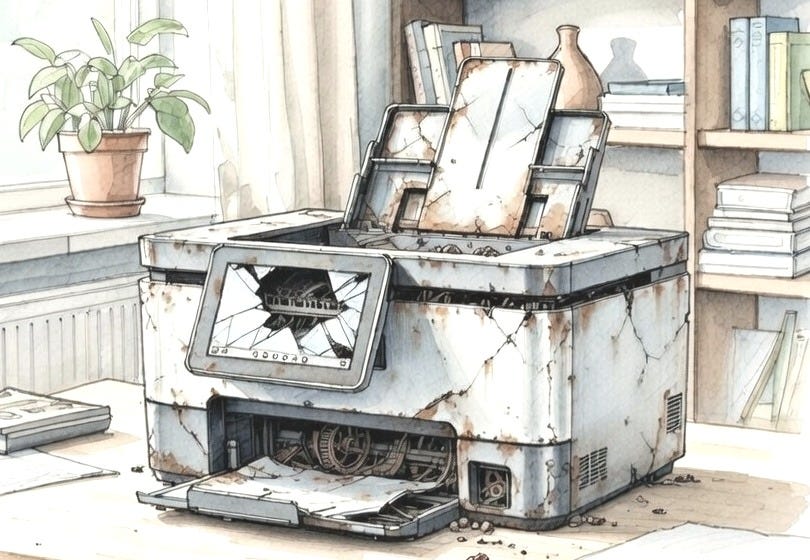
The Broken Printer
Think of it this way: you’re trying to use a broken printer. The document you send represents your lived experience, your actual words, your intentions, but it never prints the way you intended. You adjust the settings, tinker with the formatting, and try again. But the output keeps coming out wrong garbled, distorted, and backward.
So what do you do? You don’t keep pressing print or staring at the page hoping it’ll fix itself. You pry open the plastic casing and hunt down the manual so you can look at the mechanism.
That’s what I’m trying to do here: stop arguing with the printout and look at the mechanism — antisemitism as an interpretive system with built-in self-confirmation.
Social theorist Moishe Postone gives us its engineering diagram: a structural explanation for why modern antisemitism functions differently from other forms of hatred. Historian Bruce Mazlish gives us the operating conditions: how mass psychology becomes history, how shared fantasies become public moods, and eventually social common sense.
When you combine Postone’s structural account with Mazlish’s analysis of collective defenses, you can see what you’re dealing with: a self-sealing interpretive system — structural in its logic, psychological in its energy.
Why Scapegoating Doesn’t Explain the Holocaust
Most of us grew up with a common-sense story about scapegoating: times are hard, a society needs someone to blame, so it picks a vulnerable minority, pins the crisis on them, and vents rage downward. That story explains many forms of hatred and persecution throughout history.
But it does not fully explain the Holocaust.
In the final years of the war, when Germany was desperate for transport and manpower, the regime still diverted capacity to deport Jews to extermination camps. Extermination took precedence.
This is what it looks like when a society believes it is fighting an existential enemy whose destruction matters more than victory itself. Jews weren’t being scapegoated for a crisis; they were being treated as a metaphysical threat. The killing wasn’t instrumental… it was redemptive.
Saul Friedländer coined the term “redemptive antisemitism” to describe the belief that Jewish destruction is necessary for salvation. I’m tempted to call the final step redemptive killing: the moment extermination becomes the point, not the means. The moment when facts can no longer function as correction, because they’re answering to a framework that operates at a different level entirely. What Jews are, say, or do becomes immaterial. Jewish existence itself blocks redemption; it has nothing to do with behaviors.
The killing becomes logical because disproof is no longer an available category.
The Structure: How Capitalism Creates a Faceless Enemy
So why does the system so often take the form of conspiracy? Why is it about the obsession with invisible domination, hidden plots, secret control?
Postone’s answer drops one level down to the structure of modern social experience itself.
Under capitalism, power is lived in two registers at once. One is the concrete world of production: labor, factories, machines, the visible work of making things. The other is the abstract world of circulation: finance, credit, interest rates, the impersonal logic that seems to move everything while remaining untouchable.
In reality, these dimensions are inseparable, as production depends on circulation and circulation depends on production. But we don’t experience them that way… we experience them as split.
Think about losing your job. That’s concrete — you know the building, the boss, the day it happened. But why did it happen? “Market forces,” “the economy,” “restructuring.” Those words feel real, but you can’t touch them —you can’t march on “the market” or punch “interest rates” in the face.
Capitalism generates power that governs your life without a body — faceless, impersonal, everywhere. And faceless power produces a craving for a face: someone to blame, someone to point at, someone to hate. When suffering is structural, it becomes a cognitive itch, because “this is how the system works” is harder to metabolize than “someone is doing this to us.”
Modern antisemitism has an answer: “the Jew.”
Once “the Jew” is cast as the carrier of abstract domination — the personification of finance, speculation, rootless cosmopolitanism—contradiction stops functioning as falsification. Instead, it becomes evidence of the enemy’s mutability. The target isn’t a person you can investigate; it’s an explanatory slot that must remain filled.
Postone describes a Nazi propaganda image that captures the entire psychosis: a strong German worker — sleeves rolled up, rooted in the soil, productive—threatened from the west by a plutocratic capitalist in a top hat, and from the east by a Bolshevik commissar with a rifle. And above them both, pulling the strings: “the Jew.”

It doesn’t make sense. A Jew can’t be both the capitalist and the communist, both the decadent parasite and the revolutionary threat. But sense-making isn’t the point: “the Jew” becomes a single explanatory object that can absorb every crisis, fear, and contradiction.
The Loop: Why Contradiction Becomes Proof
Here’s the twist: contradiction doesn’t weaken the claim; it fortifies it.
You might recognize this pattern from a more intimate scale. If you’ve ever been in a toxic family structure, you know how this works and how the designated problem person can’t win. If they’re quiet, it’s sullenness; if they speak up, it’s aggression; and if they try to fix things, it’s manipulation. The role is the point — someone has to carry the blame so the system doesn’t have to look at itself. Then, every action gets converted into evidence that confirms the original assignment. This isn’t to psychologize history; it’s to name a recognizably unfalsifiable role-structure.
What happens in dysfunctional families also happens in societies. The same structural need for a blame-carrier, just scaled up. Across contexts and across centuries, inconsistent accusations don’t count as disproof; they’re treated as evidence of the enemy’s adaptability, cunning, chameleonic nature. The system reads reality through a converter that guarantees every input confirms the original suspicion.
Watch the same loop play out in three different moments:
Dreyfus, 1890s France: A Jewish officer insists on his innocence. The insistence is read as calculation. Calculation confirms suspicion.
Poland, 1968: A Jew (“Zionist infiltrator”) demonstrates ideological loyalty to the communist state. Loyalty is read as infiltration. Infiltration confirms suspicion.
After October 7, 2023: Jews name fear and grief in public. Naming is read as propaganda. Propaganda confirms suspicion.
Different centuries, different political systems, the same conversion process: input > interpretive grid > confirmation.
When contradictions emerge, the system converts them into proof of the enemy’s ability to disguise itself, and once installed, the interpretive machine can mutate indefinitely while preserving its function.
Mazlish, drawing on historian Norman Cohn, helps explain how a fabricated explanatory object hardens into warrant. Fantasies — the Protocols of the Elders of Zion, hidden plots to control the world — can escalate into beliefs that authorize extermination. Once the framework is in place, it doesn’t need new evidence because it generates its own.
How a System Holds at Scale
A reasonable objection: the Holocaust wasn’t one person’s delusion; it was a social reality. Millions participated, collaborated, or looked away. So how does a psychological dynamic become historical force?
Mazlish is useful because he shows, methodically, how private fantasies scale into public moods. Group psychology isn’t a pile of separate pathologies; it spreads by imitation, suggestion, and moral contagion until it starts producing its own corroboration. The danger isn’t merely error, but the degradation of corrective feedback. A collective mood becomes a permission structure — tilting interpretation toward escalation, filtering reality through fantasy, and naming the fantasy “realism.”
Postone has a term for what happens next: sleepwalking — an insistence on not wanting to know. Evidence can be present and still fail to count. How else could people live next to a concentration camp and claim ignorance? It’s not that information is unavailable; rather, acknowledging it would collapse the self-image that makes ordinary life possible. The facts are there; it’s just that the community has made them unusable.
That’s what it looks like when epistemic possibility narrows through collective defense: the group protects itself from unbearable truths by rendering certain kinds of knowledge socially illegitimate, morally suspect, or psychologically impossible to hold.
The Reassignment of Roles
Here’s where it gets contemporary.
Postone’s most diagnostically valuable analysis concerns the post-1967 New Left — the moment when parts of the global left began reframing Israel and Jews within a moral binary of oppressor and oppressed.
Context matters here: In June 1967, Israel faced what appeared to be an imminent coordinated attack. Egypt expelled UN peacekeepers, blockaded Israeli shipping, and massed troops on the border while forming a military alliance with Jordan and Syria. The war lasted six days, Israel survived, and in surviving, captured the Sinai Peninsula, the Golan Heights, the West Bank, and Gaza.
Before 1967, Israel could still be narrated as David: a small, vulnerable state surrounded by hostile neighbors, a refuge for Holocaust survivors, the underdog. After the Six-Day War, that story became harder to tell because Israel now controlled territory and had military power. It had won decisively.
For parts of the global left invested in the idea that moral clarity flows from identifying with the powerless, this created a category problem. But prioritization doesn’t automatically guard against antisemitism; it can actually provide a mechanism for it, by flipping the moral roles as soon as Jews are no longer readable as vulnerable.
Jewish sovereignty, Jewish military capability, Jewish self-defense: a disruptive trifecta on the category map. Rather than revise the map, the framework relabels the actors —“Victim” and “Oppressor.” It works because these aren’t neutral descriptions; they’re structural roles that sort the world into the binary that the moral system depends on. Without clear heroes and villains, the logic falters, and it can feel like the ground drops away. Add complexity and moral certainty dissolves; the simple story that made action feel self-evident stops being simple.
What It Feels Like to Be the Target
This isn't just theoretical. When you're inside the machine, you feel it — what people assume before you speak, what they’re ready to hear, and what they’ve already decided your words will mean.
So what do you do? You try to adapt by monitoring your tone, context, and affect. You try to speak the language of the room, hoping not to trigger the misreading. And then you realize: the misreading is the point. The system is built so that any move you make can be converted into confirmation.
Try to defend yourself calmly; you’re calculating.
Get angry, you’re aggressive.
Call out the pattern, you’re paranoid.
At that point, you’re defending more than yourself… you’re defending the very possibility that your defense could count.
Interpretive Interruption
So what should we do?
If Postone is right that modern antisemitism has a mission-quality — a drive toward annihilation, a personification of abstraction that makes the target metaphysically necessary — then better information won’t be enough. If Mazlish is right that group moods can become self-propelling, the problem isn’t simply argument. It’s containment: preserving the conditions under which reality can correct fantasy.
That’s interpretive interruption: refusing the frame that pre-decides what Jewish speech can mean and insisting that facts be permitted to matter. We must demand that Jewish self-description be allowed to count.
But here’s the turn that matters most: interpretive interruption isn’t only something Jews ask of the outside world. It’s also a discipline Jews owe themselves — not as self-blame, but as a question of what sovereignty makes possible.
I’ve been reading Robert Katz’s Antisemitism and the Law, which examines Israeli Supreme Court Justice Haim Cohn’s dissent in the Rufeisen case — a dispute over who counts as a Jew for citizenship, and thus over what sort of Jewish state Israel meant to become.
Cohn wasn’t only arguing law; he was issuing a moral warning about what trauma can do once Jews finally have sovereignty. His question haunts me: Does Jewish power require reproducing the exclusionary logic once used against Jews? Or is sovereignty precisely the ability to refuse that inheritance?
Cohn’s deeper point may be epistemic. If the state defines Jewishness primarily in opposition to Christianity — if Jewish identity is constructed as not-Christian, against-Christian — then the Christian world remains the measuring instrument. The old antagonist keeps veto power over the terms, even in the afterlife of antagonism.
Trauma becomes the author of identity.
This feels related to what I’ve been wrestling with: antisemitism doesn’t just misread Jews; it narrows what can count as Jewish meaning in the first place. And I worry we can sometimes reproduce a version of that narrowing inwardly, when Jewishness becomes defined mostly through enemies, exile, and response.
The world tells us who we are by telling us what we aren’t. And when we internalize that grammar, we can end up carrying the machine forward ourselves, even with the best intentions.
The alternative isn’t forgetting, and it isn’t pretending the threat isn’t real. I think it’s authorship: refusing to let vigilance become identity and refusing to let inherited antagonism set the limits of Jewish meaning. Interpretive interruption — outward and inward — means widening the aperture: making room for complexity, desire, and creation, for a Jewish life that can defend itself without being organized entirely by defense.
Sources
Mazlish, Bruce. “What Is Psycho-History?” History and Theory 8, no. 1 (1969): 1–20. https://www.jstor.org/stable/3678921.
Postone, Moishe. “Anti-Semitism and National Socialism: Notes on the German Reaction to ‘Holocaust.’” New German Critique, no. 19 (Winter 1980): 97–115. https://www.jstor.org/stable/487974.
Thank you for engaging with my work. If I missed a citation or made an error, please let me know. And if you cite or share my work, I’d be grateful if you credited me.
Fine essay, and spot on.
We are everything that can be hated. Everything we do is hateful, or else it is done to mask what else we are doing that is hateful. And we unknowingly brag about it when we are condemning ourselves.