
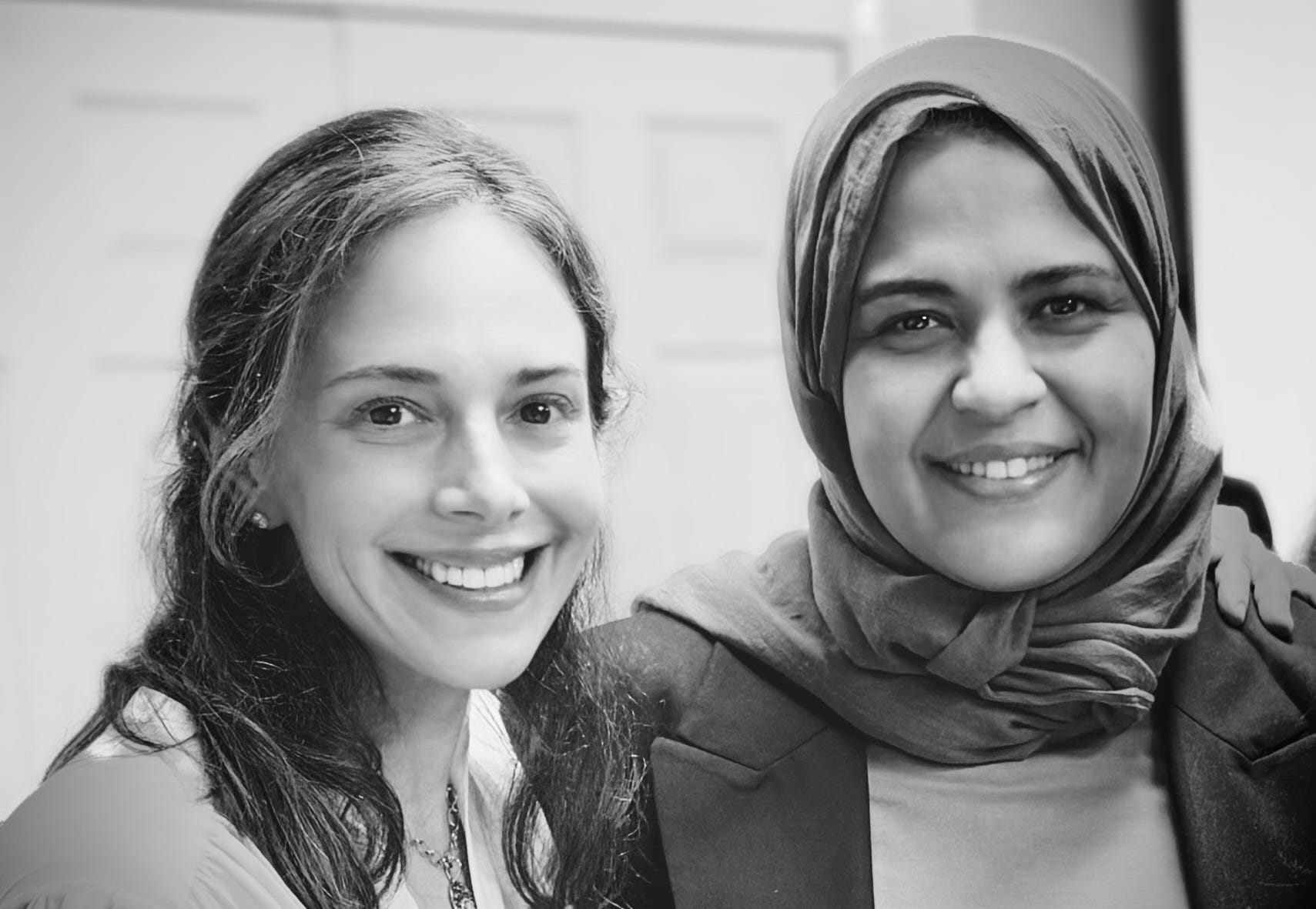
“Your blood is sacred no more.” That is how Dalia Ziada explained the fatwa issued against her, on Shai Davidai’s podcast last year. The fatwa meant that the protection civilization is supposed to extend to a human being had been withdrawn, and the withdrawal had been pronounced by a religious authority equipped to make it stick. She left Cairo because staying would have killed her.
Dalia is an Egyptian writer and political analyst, a devout Muslim — an Arab Spring figure who never stopped, a critic of Hamas and political Islam, a senior fellow at think tanks across three countries. She now coordinates the Washington office of the Institute for the Study of Global Antisemitism and Policy. For the past two academic years she has been visiting American campuses with Hillel International, speaking from inside her own tradition to audiences mostly unequipped to hear her.
When I saw her last week, Dalia made an unexpected observation: “Israel is the glue holding the Jewish people together.”
Even though I was raised secular and live a secular life now, I know and feel this in every part of who I am. And yet, since October 7, the voices telling the Jewish people, telling me, threaten to drown out that knowing.
I wanted to understand when it had clicked for her — personally, not analytically.
“It clicked,” she told me, “after October 7th, when I got to the United States and saw what the Jewish community was suddenly absorbing.” What she saw was a structural inversion of the standard story.
The standard story is that Western liberal democracies extend protection to Jewish minorities, and treat Israel with measured criticism, as parallel signs of their own liberalism. Dalia’s claim is the opposite: that the Jewish communities in Western societies are one of the main reasons those democracies are still standing — and that what holds them together, as Jewish communities, is Israel. Because a people without a place is held together only by memory, and memory eventually attenuates.
The argument runs through social cohesion, a sense of belonging.
The Muslim Brotherhood’s long strategy — what its own documents call Civilizational Jihad — is calibrated to a Western world that has become post-belonging, post-collective, atomized into individuals who no longer experience themselves as bound to anything larger than their own preferences. Such a world is permeable because there is no shared substance to defend. And the strategy works because the target stops being a society in the demanding sense — in the sense that, together, despite differences, we are responsible for one another. We become merely a population.
But somehow, despite outdated, often ineffective Jewish institutions and scrambling efforts to “combat antisemitism,” Jewish communities in the West have retained that demanding sense, alone, among groups of comparable visibility. Kol Yisrael Arevim Zeh Bazeh — all of Israel is responsible for one another.
We are still a people that cohere, and after October 7th the cohesion intensified rather than weakened. Dalia takes this to be an important political fact in the West right now. In the United States, most American Jews have decided not to stand down, not to capitulate to a false narrative. That decision has helped hold the country to its commitments in ways the institutions of American liberalism, on their own, could not.
The conclusion: Jewish communities aren’t just beneficiaries of Western liberal democracy; they are one of its load-bearing walls.
Your blood is sacred no more.
That is also, exactly, how it feels to be Jewish right now.
There is, in our moment, an architecture around Jewish life — a frame that decides in advance what Jewish danger means, what Jewish speech is for, what counts as vulnerability and what counts as manipulation. The fatwa against Dalia was issued in language that frame would recognize. The kill order against Jews has arrived in a different language, from different authorities, but the structure is the same.
Blood declared unsacred; the ordinary safety most of us can count on, withdrawn. Whoever wishes to do so, may.
Historian Shulamit Volkov has written about Jewish scientists in Imperial and Weimar Germany — Nobel laureates, university chairs, directors of the Kaiser Wilhelm Institute — people whose prestige was as real as prestige gets. In 1933 it was revoked as a single transaction. The work hadn’t changed and hadn’t been reassessed; what changed was that the role authorizing the prestige had been retracted. Safety has the same structure. If protection can be withdrawn on command, it was never fully protection.
“Antisemitism came for me too,” Dalia explained. She was condemned because she spoke out against Hamas, supported Israel’s right to defend itself; because she said in public what she had concluded in private.
The price has been the same.
In her interview with Davidai, Dalia shared something else worth noting: She learned her resilience from the Jewish people. The witness was also a student, and her account of Jewish cohesion holding the line is the report of someone who has personally survived by following the example.
She is, in short, not a sympathetic outsider offering solidarity; she is a strategic analyst who has spent her career mapping the architecture of power in her region, and she has paid for what she has seen.
What Dalia said to me last week extended beyond the politics of recognition. It was something entirely different — it was the other kind of being seen, the kind that is usually unavailable to the Jewish people.
The politics of recognition is vertical. One party recognizes; another is recognized. The recognizer occupies the higher position by virtue of holding the verdict. Even sympathetic recognition operates within that asymmetry: we have looked at you and decided you are acceptable. The grammar places the speaker above the subject, and to accept the recognition is to accept the position.
What Dalia offered was horizontal. It had nothing to do with acceptance, permission or sympathy — she said something cooler and more astonishing: you are the load-bearing wall. You are why the rest of the structure has not yet fallen, and the countries where your people held their ground have held their ground. The countries where it didn’t, haven’t.
This is what I see. It is an observation, made by someone whose vantage point is unusually clear and whose incentives to make it are unusually weak. The position from which she speaks is not above the subject; it is alongside it, looking at the same picture.
This is what testimony, properly understood, sounds like. It’s not a verdict from a tribunal, but a report from a witness. It’s also what we have been waiting for, and what we have stopped expecting.
For so long the available register has been the tribunal one: are you good Jews or bad Jews, are you the kind of Jews we like or the kind we don’t, can you condemn enough, soften enough, qualify enough to be permitted into the room. Even the friendlier versions of the question carry the same architecture. We are typically being graded, the subject of a sentence whose verb belongs to somebody else. This perpetual degradation of our voice is what philosopher Miranda Fricker calls “testimonial injustice” — the harm of having what you say received as needing to be discounted because of who is saying it.
For Jews speaking about antisemitism, the discount has been a near-constant. The report is reclassified as exaggeration, the alarm as advocacy, and the wound as bid for advantage. The act of testifying becomes evidence against the testimony, and the speaker is left holding the proof of something that, by the time she has finished proving it, has been resealed against her.
And then someone walks in from outside the entire frame and says, simply: I see what is actually happening. Your people are holding the line; the line that everyone else thinks they are holding for themselves, they are holding it because you are holding it. Without you, the rest collapses on a timeline I can already read.
What such a moment brings, when it finally arrives, is relief. It’s not vindication or satisfaction. It’s just relief. Relief at being seen accurately, in a way that asks for no performance, by someone whose seeing was never conditional on it.
This is what it feels like to be recognized as people. As people in the strong sense: as a collective with a history, a structure, a function in the world that is visible to a careful observer. Not as a problem to be managed or as a case to be heard, but as a fact about reality — about what’s true in the world.
We have not been seen this way in a long time.
There is one thing more, I wanted to mention.
The night before Dalia fled Cairo, she sat at her window and watched the sun set for an hour. She told herself she would not see it again. She has told the story since, through tears, on Davidai’s podcast.
Last week, I gave her a small thing, a Seal of Solomon pendant. I bought it years ago in Israel, dipped it in the waters of the Mediterranean — meant to protect me and now her. I warned her twice it was probably not real gold, and not to wear it in the shower. We squeezed each other’s hands.
Imagine what that hour at the window was. The light on the buildings she had grown up looking at. The color the dust took in the late air. The city falling into evening exactly as it had every other evening of her life, with no concession to the fact that she was leaving. She was memorizing what until that night had not needed memorizing — the ordinary, the given, the background against which a life is lived. The sunset had not been a thing; it had been the air the things were in. Now she had to carry it inside herself, because the place that held it had become a place that wanted her dead.
The world in which she can return to that window is the world where the fatwa against her has been lifted because the conditions that produced it have collapsed. It is the same world where Jewish blood is sacred. Her safety and ours are one condition.
Until Jewish life is safe again, Dalia cannot go home.
And until Dalia can go home, we are not safe either.
The memory is not enough.
She should have the sunset.
Sources
Fricker, Miranda. Epistemic Injustice: Power and the Ethics of Knowing. Oxford: Oxford University Press, 2007.
Volkov, Shulamit. Germans, Jews, and Antisemites: Trials in Emancipation. Cambridge: Cambridge University Press, 2006.
I didn't realize how much I needed this perspective. Thank you for writing this.
"Imagine what that hour at the window was. The light on the buildings she had grown up looking at. The color the dust took in the late air..."
WOW. And that was AFTER the Seal of Solomon paragraph that near broke me.
You're a Wonderful Writer.
And you've got a GOOD. HEART.
Why, evidence to that end is written all over the page!
Subscribed,
גברתי