
This piece originally appeared in Jungle World (German) and The Times of Israel.
“It is a worthy dream; many of us still hold on to it.” — Shulamit Volkov
I learned the word “ansteckend” on a bus in Weimar. Someone yawned, and then I yawned, and then two other girls yawned, and someone said that yawning was contagious — ansteckend — and that was how it entered my vocabulary. On a bus, in the early morning, in May, in a city that had once held within a few kilometers the highest aspirations of European civilization and the worst atrocity it ever produced.
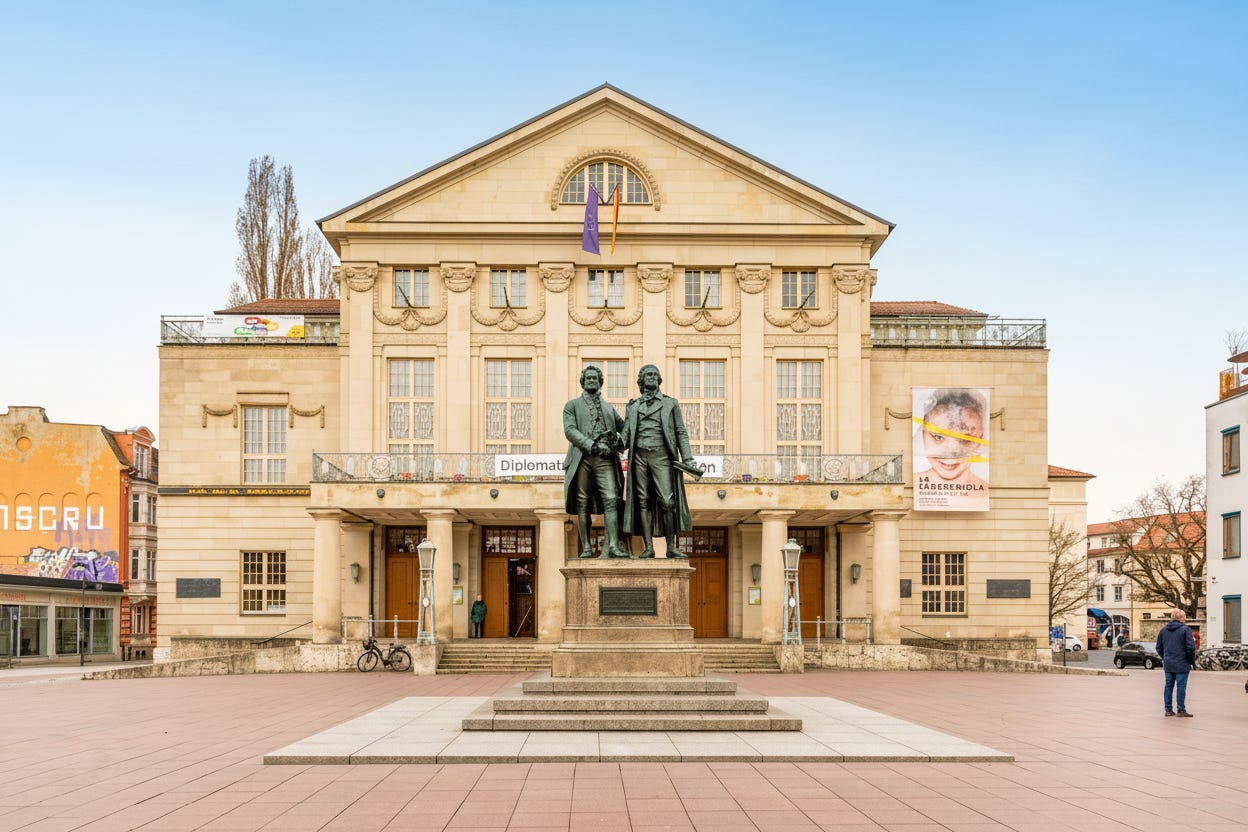
Weimar is that kind of place. Goethe lived here, Schiller too. Nietzsche spent his final lucid years in a house on the Frauenplan before his mind gave out. Bauhaus was founded here. In 1919, the first German democracy was proclaimed here because Berlin was too unstable. And eight kilometers up the road, on the Ettersberg hill where Goethe used to walk, the regime that destroyed that democracy built Buchenwald. The distance between the Goethe-Schiller monument in the town square and the camp on the hill is not a paradox that requires explanation; it’s just the distance. And you feel it when you live there.
I spent time there as a teenager — a Jewish American girl whose grandmother had come from Germany, riding that bus to school in the mornings, walking the muddy streets, learning words. This was several years after the Wall had come down, and Weimar was becoming bright and alive, new paint going up over old façades, the future being laid over the past in real time. But the past was still physically present. My host family’s bathroom still had the old East German tiles, brown, with blue and red rims around the faucets. In the kitchen there were utensils stamped with the names of manufacturers that no longer existed. The city was shedding its skin, slowly, so you could still see what was underneath.
Earlier this month, the German court upheld a ban against a group called “Kufiyas in Buchenwald.” They had planned a vigil at the concentration camp memorial — to protest, in their words, “the genocide currently taking place in Palestine.” The protest was moved to a square in the city instead.
I felt relief. And then the jolt of the uncertainty about next time.
My host parents had grown up in the former East Germany, in a state that had declared itself antifascist by decree, largely leaving the actual reckoning to others. Sometimes on weekends I sat with elderly people over Kaffee und Kuchen who told me, with wide eyes, how terrifying the Allied bombings had been — their voices carrying a weight that seemed to want something from me, but I was too polite to say what I might have said. I’m not sure I even knew what I was thinking. It was only later, looking back, that I understood why this may have felt awkward — the Jewish American girl in the room, trying to be a good guest, while something much older moved beneath the surface of the conversation.
One weekend I took the train to Dresden with a friend. Her stepbrother showed us around. It seemed like everything was under construction. After a boring boat ride along the Elbe, we hit the shops and my friend bought orange platform sneakers. That night, we danced until three in the morning at a techno club and woke up to the most delicious smell — Rinderrouladen. That afternoon, the family ate and sat together. Someone showed me a book of photographs of Dresden before the war — a city of extraordinary beauty, documented as if in anticipation of its own destruction. Someone brought out the photo albums. Paging through them, I noticed the small circular pins on the lapels of relatives in some of the family pictures.
I didn’t know what to do with any of it. I was a teenager with a messy ponytail and circles under her eyes who had been dancing until three in the morning. I kept passing the cake.
My host mom was a teacher at my school. At home she was warm and funny — the kind of person who noticed everything, who always made sure we didn’t run out of Nutella, who secretly cleaned the mud off my shoes after I went to sleep, because I couldn’t understand why I should do this when the shoes would keep getting muddy. She had a sharp enough sense of humor to mention to a colleague, in front of me, “Joanne always leaves the house with wet hair.” She wasn’t being unkind. She was being honest, the way people are honest about someone they’ve absorbed into their lives. At school she was one of the teachers and I was just another student — which was, I came to understand, its own form of love.
One evening her daughter and I got the giggles at dinner while great-aunt Ilse was visiting — the unstoppable kind — and were sent upstairs for being “rude.” We sat on the stairs and tried to muffle it and mostly failed.
Her husband was quieter, but no less present. He had built their house with his own hands, the way people in the former East Germany learned to make things work. He could build or fix anything. When he smiled he would blink slowly, like a cat in a patch of sun. He spoke in the heavy dialect of the region and I learned to understand it; it sounded rich and warm, like something that had been lived in for a long time. In the evenings they listened to hits from the 60s and 70s. They loved Joe Cocker; I teased them about it, called them the “Joe Cocker Club” — and sometimes that music would follow us into the car on longer drives, the windows fogging a little at the edges.
One of those drives took us to Nuremberg, the city where my grandmother had spent part of her childhood. I should say: my grandmother was born in America, to German parents who had come over around the turn of the century — part of that earlier wave of German Jewish families, assimilated, prosperous, the kind of people who belonged to the Ethical Culture Society. But my grandmother’s family had gone back to Germany for a time, and she had grown up partly there, in a large house in Nuremberg, surrounded by cousins. She remembered being in Hamburg when someone threw a rock at their car. She remembered coming back to America poor, unable to speak English, but with beautiful clothes — and being elected class president anyway, until a teacher said the class shouldn’t have voted for the best-dressed girl with broken English. My grandmother told the teacher that had hurt her feelings. The teacher apologized, they kept in touch, and my grandmother invited her to her wedding.
By the time I knew her, Germany was not something she spoke of much. I think she had let it go long before the war made letting go obligatory — let it go in the ordinary way of immigrant daughters, embarrassed by a mother’s thick accent, a mother’s body, the visible foreignness of the life they had left behind. The house in Nuremberg belonged to a self she had already set aside.
But I wanted to find it, and I had an address — a number, a coordinate for something I had never seen and she no longer claimed.
Joe Cocker on the radio, my host mom telling my host dad to stop driving so fast on the autobahn and my host sister snoozing on my shoulder in the back. The four of us winding south through Thuringia toward a city I knew mostly from its other history — the rallies, the laws, the trials. We found the street or found where it should have been. The building was another building. So much of the city had been destroyed during the war that whatever my grandmother had known — the rooms, the cousins, the life before — was replaced by the rebuilt city going about its afternoon. We drove past the Palace of Justice, where the trials had been held. We didn’t say very much. I got out of the car and took a photo. Afterward we ate at McDonald’s in the inner city. I went to the bathroom and had no toilet paper in my stall. When I asked the lady in the next stall if she had some, I heard how fluent my German had become.
In a few months, I would show my grandmother the photograph I had taken. She would look at it and shrug. It could have been any street corner. It meant nothing to her. The only photograph that elicited a reaction was the one I took of the Ferragamo store. I can still picture her row of shoes on the closet floor of her New York apartment — shiny black patent leather tips, neatly aligned.
I have thought about that drive many times since. They didn’t have to take me or understand why it mattered. They just got in the car.
***
Back in Weimar, I sat in classrooms and had the conversations that German classrooms were, by then, required to have — about what happened, about responsibility, about memory. One teacher drew a firm distinction between Germans and Nazis: not all Germans were Nazis, she said. I pushed back. I felt angry in a way I couldn’t quite articulate — something about the smallness of the resistance, the largeness of the compliance. She held her position because she was a history teacher and she was being accurate. I wasn’t wrong to be angry, and she wasn’t wrong to be precise, and we both knew the conversation was about something more than the argument.
I remember walking the streets and not knowing where the camp was. I knew it was somewhere nearby — up on a hill, outside the city — but I couldn’t locate it, and for some reason I needed to. Every fence I passed, I wondered: maybe that’s part of it. Maybe that? It wasn’t until later that I understood you couldn’t see it from the city. That was, I came to think, its own kind of information.
And then one day we went.
We stood in the school courtyard waiting. The half silence of teenagers who understood, in some unspoken way, that this field trip was different. And then the ordinary sounds that filled it anyway — gum being chewed, backpacks zipping, someone dropping something on the ground with a thud. A murmur of kids who didn’t know what else to do with their hands. We could have grown up together, in a different history. Some of them knew that.
Inside, I remember the clock — stopped at the moment of liberation, the hands fixed at the hour the Americans arrived. I remember learning that the SS had built a zoo there — bears, monkeys, deer — funded by forced “donations” from the prisoners, maintained a few meters from the crematorium. Guards could be punished for mistreating an animal.
I remember wondering which people from the city — from my streets, from the buses I rode — had worked there, or known, or looked away.
I felt self-conscious the entire time. I was aware that people who knew I was Jewish might be watching me, curious how I would react. I tried not to react. I felt responsible, somehow, for not making it too much — for managing my own response so that no one around me would be uncomfortable. The memorial was sterile and carefully organized, and it didn’t have the gravity I had expected. The gravity, I think, lived elsewhere. It lived in the clock. It lived in the question of the neighbors. It lived in the tension of the courtyard before we left, in the sound of backpacks zipping.
My host mom was one of the teachers on the trip. When a few of us weren’t at the meeting point when it was time to leave, she chewed us out. The exchange student included. Because to her, I wasn’t a specimen behind glass or a guest to be handled carefully — I was a teenager who was late.
That mattered more to me than almost anything else from that day. The fact that she yelled at me too.
The last time I saw them both I was there with my own family. My host dad didn’t speak English, but he was the kind of person you still felt comfortable around. We left my son with him in the family room, watching YouTube, while my host mom and I went into the city to shop. When we came back they were perfectly content together, my seven-year-old and this man who had built his house with his hands and smiled like a cat in the sun.
We said goodbye next to our rental car. I needed to reverse and pull it out of a tight spot with a manual transmission. I told them they couldn’t watch — they were making me nervous. They stepped back. I stalled. I stalled again. Several attempts, several stalls. When I finally pulled out, I glanced in the mirror and saw that they had been watching the whole time, from a careful distance. I stopped the car and got out. We were all laughing too hard to do anything else.
It was 2022. We had known each other for over twenty years.
***
Earlier, before any of that, my host mom walked me back to the car. For a few seconds, we moved at the same speed; I noticed her hand at her wrist. I got in, pulled the door shut, fastened my seat belt. She stepped toward the window and held something out — her watch, modern, with a pink band, the one I had admired over dinner. She pressed it forward, I looked at the road ahead, my face hot — and then our eyes met and stayed.
When I look at the watch now, I think about what it means to hand someone time, about a German woman extending her arm through a car window toward a Jewish American woman whose grandmother’s house in Nuremberg she’d tried to find.
This past summer, my host dad died.
He had just turned seventy and just become a granddad. He had worked with his hands his whole life, and he and my host mom were finally getting to travel, to rest, to have the life they could never have imagined growing up in East Germany. And then he was gone.
She needed almost a month before she could find the words to even text me. It wasn’t because I was an afterthought — it was because she was devastated, and because telling me made it more real, and because I was someone to whom it had to be said.
I was still in touch with the friend I went to Dresden with. But after October 7, she posted antisemitic propaganda on Instagram — the kind she mistook for simply caring about humanity. We messaged back and forth. She couldn’t hear me. She thought I was the one who didn’t understand, and that growing up in Germany gave her more authority on the subject than I had.
***
And yet my host mom and I talked too.
She told me she believed Israel had a right to exist as a sovereign state. It sounds like a simple thing to say. It isn’t. It came from the same place as that text — the place that says: you are someone to whom I owe the truth.
And what I heard underneath her words was the thing I most needed to hear: you get to exist. Me. Her person, still, after all this time. The girl who left the house with wet hair, who learned the word for contagious on the school bus, whose grandmother’s house they helped her look for and couldn’t find.
I think this is what genuine reckoning looks like. The monuments, the court rulings, and the official positions of memorial sites matter. The German court was right, and I’m grateful. But those aren’t the places where reckoning happens. I think it has to happen through relationships that accumulate enough ordinary life to hold the hard things too.
This is what I think about when I read about “Kufiyas in Buchenwald.” The activists want to bring a political symbol to that hill — to make a statement, to perform a connection between one atrocity and another. I understand the impulse. This is not what that place is for.
What that place is for, or what it did for me, was something you can’t stage. It was listening to someone chew their gum, wondering which families, on which sides of which history, we each came from. It was being scolded for being late, the same as everyone else. It was not being handled. It was just being there, with people, in the normal discomfort of it.
I worry that too many people mistake the monument for the relationship, and the performance of memory for the human obligations memory is supposed to create. It is a world where a German woman and a Jewish American woman are still talking, so many years later, about muddy shoes and the Joe Cocker Club and the right of the other one to be here.
It often feels like the world is hanging by a string. I worry the law may not always hold the way it did for Buchenwald — but I’ve come to think that the law holds because of relationships like this one, not the other way around. The relationships are the anchors. They are what build and inform who we are in the world, what make us the kind of people who insist that the law hold, who notice when it might not. Without them, the monument is just stone and the ruling is just paper.
I don’t know how to protect that, exactly. I just know what it feels like to have one of those relationships. And I know that when she finally told me about Uwe, and I understood why it had taken her so long, what I felt wasn’t only sorrow. It was gratitude.
That after everything — after history, after more than two decades, after October 7 — I am still someone she has to tell.
***
In memory of Uwe
Generally less so than lies, but we live in hope.