
On the desk sat my five-year-old self in a picture frame.
“She says to hold to my truth,” I explained to my mother. “Look at her quiet resolve.”
My mother wrinkled her nose.
So I went on to mention how, the other night at dinner, I spent ten minutes in a bathroom stall crying because the veining in a marble tile resolved itself into my dead father’s face—his outline unmistakable, even down to his glasses.
“You’re schizophrenic,” she concluded.
Pattern recognition is not always rewarded. Meaning-making is easily confused with delusion, especially when it is unguarded and emotionally precise. The speed with which care, perception and interiority slide into diagnosis has long been part of our shared language.
This was our dance—circling recognition without ever arriving, like a kite almost lifting to the wind.
But the next morning, my mother told me a story.
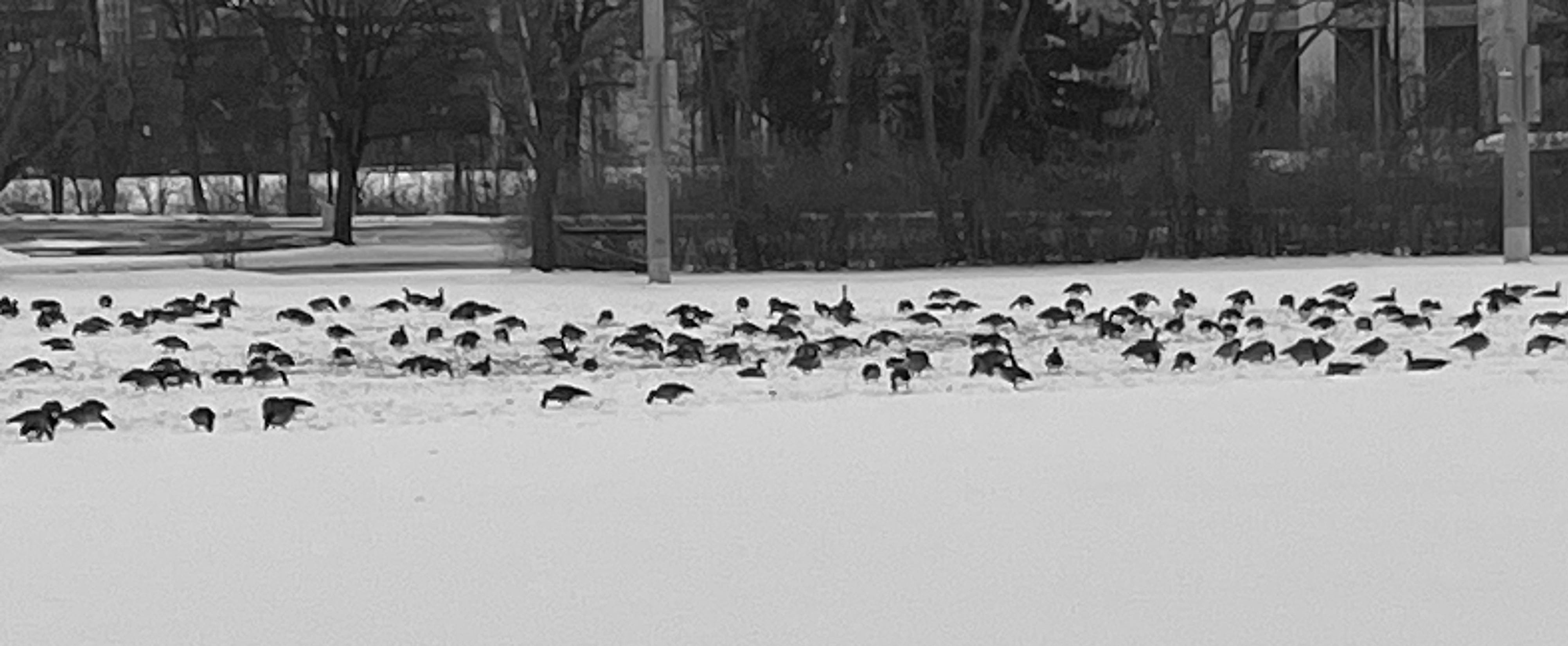
She had driven past a pond and noticed a woman feeding Canadian geese. Her first thought arrived quickly and without mercy: Why is this woman feeding these disgusting geese? The birds were a nuisance and by extension, so was the woman tending to them.
Then something unusual happened. My mother told me how she noticed the thought, how reflexively her mind reached for contempt, but how she stayed with it long enough to revise it. This woman is standing in the cold doing something kind.
My shoulders dropped.
Because I often find myself under the same gaze as the woman feeding the geese—the one whose care is mistaken for excess, whose intensity is perceived as imbalance, whose speech irritates as it rejects the emotional economy of the room.
“Why do you have to be narcissistic and make it about you?” she asked.
This time, I smiled at the old rhythm asserting itself—my interiority redirected toward self-absorption, my meanings reduced to pathology.
“You’re right,” I told her. “It’s not about me. It’s about you.”
I had come to believe the air between us was too heavy to hold even a faint flicker, that the weight of being misrecognized was no longer bearable. But this was the moment the kite caught the wind.
You will be called by your name.
You will be seated in your place.
You will be given what is yours.
The dream goes something like that.
The closing lines draw from Harvey Shapiro’s poem “On Some Words of Ben Azzai” (1963), encountered through Norman Finkelstein’s Like a Dark Rabbi: Modern Poetry and the Jewish Literary Imagination.
This touches me very deeply. I feel it and understand it. You nailed it.