
Sometimes, I go there.
To the apartment.
Usually in the minutes before sleep.
Palms pressed against the smooth, gloss-coated windowsill.
Yellow cabs blur.
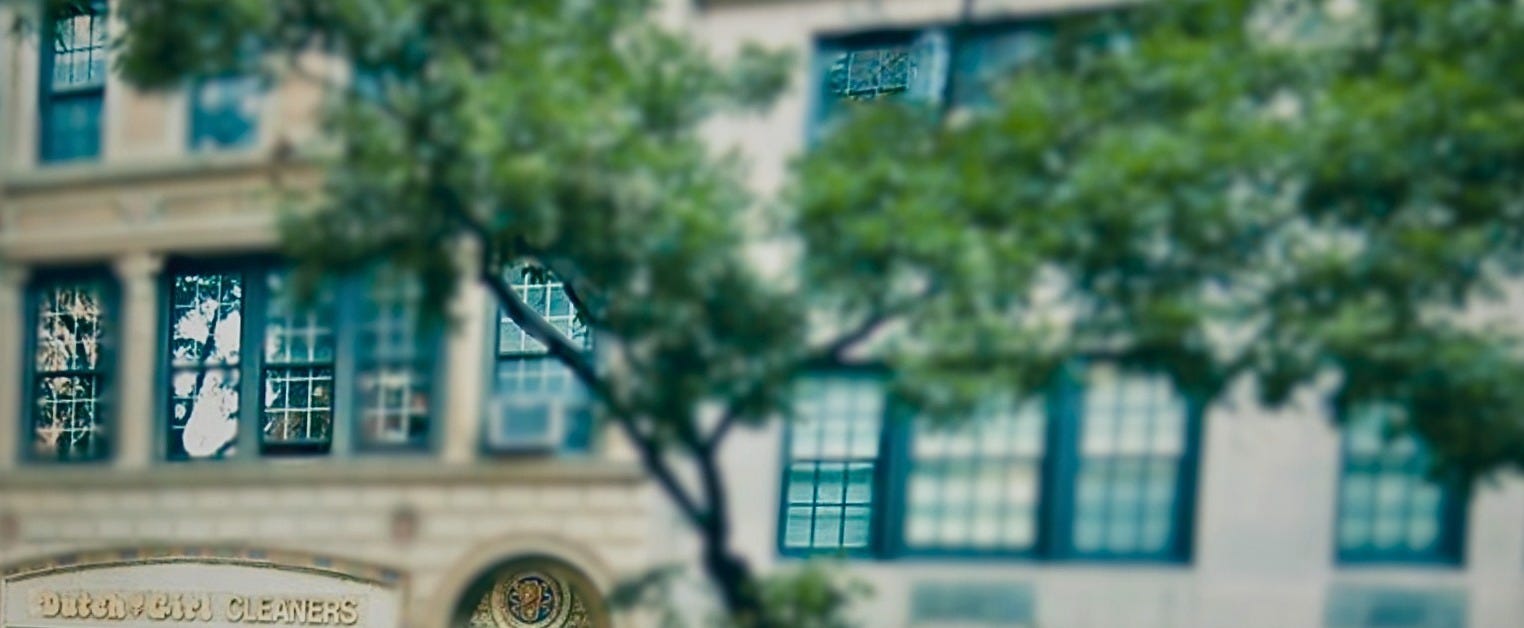
Dutch Girl Cleaners
on the west side of the street.
The rattle of the air conditioner,
the elevator gate,
muffled conversation from the other room.
Dove soap, everywhere.
If I’m honest, it’s every day—
back to a lifetime that held a different girl
until she wasn’t mine anymore—
and then didn’t.
A frame loosening,
its picture a tired sun slipping
into the current.
This water’s edge.
These lingering pieces of sky.
This place,
and the time we spent labeling pictures.
Black and white photographs—
names, captions
that I dutifully recorded,
sure they’d hold the life inside.
Imagine setting a sail
only to forget the wind,
or trying to make shadows
without light.
I lean forward—
arms stretched across the centuries,
holding on to what is ours.
Your great-grandmother’s childhood
spanning two continents:
the villa in Nuremberg,
the New York City apartment.
The points of hers and yours,
desperate to connect,
to transmit their inexplicability.
            When you got here,
            I understood I had misunderstood:
            the right stories were the wrong
            ones.
When you put me where time slows into detail
and vanishes in hindsight,
I heard the message…
like the soft insistence of wind chimes:
nothing is endless.
            The loss
            is the ache
            is the code.

            And I am a scrawny coyote
            circling the outskirts of a town.
I collect scraps and strands—
Marienbad,
the village,
words from old relatives still alive.
Is this the road
leading to the lake house?
Places leave voids,
and you can feel their shape.
You can see how they fill—
like branches and barren sky
held in the corner
of a foggy window.
             In.
            This.
            Clean.
            Light.
But maybe you could hold my hand
inside a New York winter,
the way she held mine
as we crossed over to “Lex.”
Shiny-black mink brushing my cheek
through this majestic chaos.
Horns, steam grates, rushing bodies—
translation:
you are safe with me, here.
Before you turned ten,
you mentioned you were happy
to “live in this world.”
Too delighted for curiosity,
I didn’t ask:
did you mean this one,
or the one it came from?
And later, I wondered
if it was possible that you knew about the maps—
how the streets of foreign towns
unfold like dominoes in reverse.
Maybe no one needs
a formal introduction
to alleyways.
I’m not going to ask
about the ancestors, yet.
I don’t think mentioning
the people who run at night
—through our blood,
through our veins,
through our dreams,
again and again—
would be helpful
as you become a teenager.
It would be less strange
to ask about what you notice.
Like the woman with the bun—
the way she pauses
in doorways,
her eyes run deep like wells,
but there is no darkness
in her house.
(It’s not visible from the road.
Keep looking.)
If you make it to the city,
find the other lady.
And don’t be fooled:
Schubert plays
on the gramophone,
but those mountains
never left her gaze.
            The loss
            is the ache
            is the code.

            And I am a scrawny coyote
            circling the outskirts of a town.
You and I talk a lot
about the rain.
Sometimes, it comes
in the afternoon.
The darkening of the street.
The way everything slows—
cars, voices, light itself.
That’s when I feel it—
the pull—
backward and through.
I want you to know:
this is not a lost room
you cannot enter.
I will not let this world die in my arms.
This is a piece from a longer work in progress. It comes from thinking about memory, inheritance and how we decide what to carry forward and what to hold for those who come after us.
Beautiful