
This is an excerpt from a work in progress.
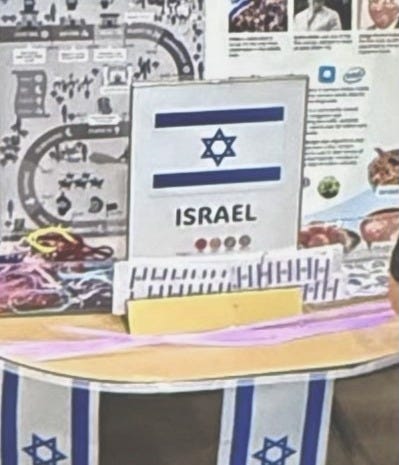
The cafeteria smelled of sugar and cumin, of starch and glue from handmade flags. Parents had turned folding tables into small nations, each a diorama of memory. Samosas under strings of lights, pierogi steaming beside printed maps. Children in sequined shirts circled the room with paper passports while teachers stamped them like friendly border guards.
The evening was joyful, and for a moment, I almost felt hopeful about election day.
Still, there is a quiet dread in being the representative of the pariah state at your child’s school. It lives in the anticipation of the unfinished sentence that hovers between curiosity and accusation: what about the… you know… genoci— As if I’m meant to finish it, to collaborate in diminishment… libel. I won’t.
No one said the word, but I sensed it hovering at the edge of conversation. Some approached my booth cautiously, careful not to meet my eyes. They studied the lower half of my display: Israel’s history of innovation, Tel Aviv’s gay pride parade, the Arab Supreme Court judge who sentenced a Jewish prime minister to jail. Their gaze drifted downward, tracing the map from the Kingdom of Judea through the Islamic conquest, Christianity, the Ottomans, eyes cast down because this history feels a slope too steep to climb.
“Did you know Israel invented voicemail?” I asked, my voice too chirpy. Heads lifted, polite laughter fluttered.
“Isn’t that annoying? I mean, who likes voicemail?”
“They also invented the Intel chip,” I added. “And whatever makes your smartphone smart.”
South Korea’s booth gleamed with precision, and Barbados overflowed with plantains and rum cake. Palestine’s tables were draped in keffiyehs, the black-and-white lattice older than the flag itself, Iraqi by birth, a fisherman’s net repurposed into a loaded symbol: Juden sind hier unerwünscht.
I had known Palestine would be there, which is why I invited the Palestinian mother for coffee a few weeks earlier. Secular, born in Palestine and raised abroad, her English was perfectly American, her laugh unforced. We spoke the language of suburban mothers—home renovations, school politics, handbags. She mentioned that when they lived in Atlanta, they spent Christmas with Israeli neighbors; I told her we could do the same here, that the Hunan Lion was the place.
When I shared my understanding of Zionism—that I was pro and pro, because without a happy, healthy neighbor Jews can never be safe—she set her spoon down and looked toward the door. For a moment I thought she might bolt. Then she met my eyes.
“I’ve never heard it explained that way,” she said. “That makes sense.”
We liked each other, though she was cautious, and I felt responsible for that caution. When I suggested we share a booth—your flag and mine, opposite ends of one table—she smiled, gracious but unyielding.
“I think we’ll do our own.”
I said I understood, and I did. I didn’t want the counterfeit unity any school loves to photograph, the curated harmony of difference, the annual proof that we are one community and “love always wins.” Still, wouldn’t it have been something, here in Columbus, Ohio, to stand together for an hour?
In another time, I might have been Germany. I speak German without an accent, eat with the fork in my left hand and knife in my right, wear house shoes, lüfte the rooms. I’ve traveled to Israel several times, but my Hebrew is fractured. My Israel lives mostly in books—in Oz and Amichai, in Under the Domim Tree, children of survivors dreaming of Europe while building a future in dust and sunlight.
I could never wrap myself in the German flag that way. The Israeli one felt less like cloth than covenant—azure blue, crisp white, royal fabric from David’s kingdom, his descendants, his daughter beneath fluorescent light in the school cafeteria. Hineni.
I had to be Israel that night, even as my chest tightened; pride and fear folding into a single current. Both stories moving inside like weather systems—the part that learned to disappear and the part that insists on standing in full view. The body knew before the mind did that this was the work, to stay in charged stillness long enough for the two selves to share breath. The disciplined one who straightens her utensils and the one who stands wrapped in a flag beneath fluorescent lights.
As the evening waned, I wandered the aisles collecting the remnants of other people’s origins: a child’s paper crown, a smudge of turmeric, the faint echo of drumming. Someone took a group photo, and I smiled too brightly.
When the lights dimmed, I folded the flag carefully, as if it were a living thing, and carried it to my car. At home, I spread it across the foot of the bed. Under the lamplight, the blue stripes shimmered faintly, neither solemn nor triumphant, merely awake. I lay beside it, exhausted by diplomacy. The fatigue wasn’t physical but the ache of containment, of translating existence into something safe for others to absorb. To be the right kind of Jew is to anticipate the gaze before it lands.
“It’s nice to see Israel and Palestine talking,” Lebanon said as we packed up.
Of course they noticed. If I hadn’t known they would notice, I wouldn’t have sweated through my dress or practiced my smile. It shouldn’t have to be that way. China didn’t have to play defense.
And yet, after the largest massacre of Jews in a single day since the Holocaust, the expectation lingers that we perform our humanity and make ourselves safe to sit beside, if we wish to attend.
The next morning, the cafeteria would smell of disinfectant and chocolate milk. Children would line up for lunch, paper flags crushed in the trash. But that night, as sleep blurred the edges of thought, I could still feel the flag’s weight across my shoulders—light, royal and unbearably alive.
A powerful piece. I love the line about building a future in dust and sunlight.
I could feel it all in my heart. So powerful.