
Last Sunday at the Montreal airport, a stranger asked where I was headed, and I said Vienna. It was true the way the easier thing is true: I was changing planes in Vienna and flying straight on to Tel Aviv. The word Israel stayed in my mouth. Saying the easier thing took so little effort that I barely registered the choice.
I was traveling to Haifa, to a conference where, for four days, every aspect of contemporary antisemitism from every corner of the world was tackled — and where we launched the Contemporary Antisemitism Studies Association (CASA), spearheaded by sociologist David Hirsh, who has been drawing this map since almost nobody wanted to admit the territory existed. The association is a partnership spanning Gratz College in the United States, the London Centre for the Study of Contemporary Antisemitism, and the Comper Center at the University of Haifa. This is my field. I came to it through curiosity and study. And then, for some of us, October 7 clarified that this was now an active condition, and we had a real research problem on our hands.
There were dinners and wine with colleagues from Austria, Germany, Britain, France, and beyond. The most honest thing I can report from all of it: none of us pretended to have the answers. What we have is humility, a commitment to rigor, and a willingness to work together, which turns out to be a research method.
Four days later, at Ben Gurion Airport, I chatted with an older couple on the first leg of the trip home, Tel Aviv to Vienna, and then on to Chicago. Somewhere over Turkey, the woman told me about her last trip to Chicago to see her daughter. In a café in Chicago, a young man had asked where she was from, and she said Germany. She is Israeli. She told me she still felt ashamed of the answer, and I told her the most important thing is that she protects herself. She is my mother’s age. I knew the shame she meant because I had felt a smaller version of it in Montreal and filed it under convenience.
For the rest of the flight I sorted the four days.
The night before I left, Bernard-Henri Lévy had closed the conference under the stage lights, looking tired. I had seen him speak a year or so ago when he came to Ohio State, and I remembered the force of him; the tiredness seemed new.
Fifty years ago, Lévy told us, he wrote that antisemitism moves like a virus, mutating its wording with each generation, and that its next wording would be Israel. Everyone asks whether antizionism is antisemitism, he said, and the question runs the wrong direction. The old fuels are spent: nobody assembles a mob anymore over deicide, or over Voltaire’s contempt for the people who produced Christianity, or over the racial pseudoscience of the nineteenth century. Ask instead whether antisemitism today can be anything other than antizionism. Convince the world that the Jewish state commits apartheid and genocide, that Jews everywhere are complicit, and millions can hate in good conscience.
He had toured the American campuses to see it up close — protesters chanting the slogans, Jewish students keeping Shabbat with fear in their bellies. The protesters, he said, were no worse than he had been at their age. They believed they were defending the weakest people on earth. Their hatred spoke the vocabulary of love, and he said the encounter chilled him in a way fifty years of writing about the subject had spared him.
That morning a journalist had asked him whether French Jews should emigrate as their grandparents should have in the thirties. To go where, he answered. In the thirties there was America; there was the Yishuv, the Jewish community building a homeland in British Mandate Palestine before statehood in ‘48. Today the wave is worldwide.
And when the sexual atrocities of October 7 came up on stage, he named their reception: “the will not to know.” Real academics, great teachers, had looked him in the eye after the evidence was public and said they did not believe, or that it was not without context. In France, in America, in the UN. Beside him on stage sat Dr. Cochav Elkayam-Levy, who had spent those same two years assembling the most comprehensive documentation of those crimes.
And still, after all of it, Lévy expressed hope and optimism. I didn’t hear it as his though; I heard it as an act of transfer. He was passing a torch to the rows in front of him, trusting that my colleagues and I would carry the ideas that matter, would serve as a weight when the world spins with algorithms too fast for anyone to steer.
The ideas he was trusting us with were the ones I discovered as a girl in Ohio. I was fifteen when I first saw the black-and-white photograph of Hannah Arendt leaning over a desk — a woman thinking for a living, the thought visible on her face. I understood something I could hardly have phrased then: ideas were a place a person could live. They could matter more than the room you stood in, the town, the decade. A girl in Ohio could belong to them, and they would have her.
Days earlier, in a lecture hall in Haifa, sociologist Karin Stögner had given the talk that returned me to that moment when I learned the name of these ideas. Critical theory began in Frankfurt in the 1920s and ‘30s as a refusal to take society at its own word — a way of asking how domination survives inside categories that feel natural, and of keeping thought supple enough to catch it. By 1940, Adorno and Horkheimer had placed antisemitism at the center of the inquiry: the hatred that makes a complicated world feel simple, that bridges the contradictions of modern life by giving them a face.
Early in her talk, Stögner addressed Nancy Fraser’s essay, “Gaza as World Event,” which argues that the Holocaust-centered moral order governing the West for half a century is in crisis — that Gaza now “bids to replace” Auschwitz as the era’s symbol of atrocity. It is a sweeping essay, a travelogue through Germany, America, world Jewry, Japan. And in every location it makes the same discovery. Jews who testify to antisemitism are exercising power: their testimony arrives pre-labeled as a weapon, a pretext, an instrument of repression. Jews who renounce Israel carry a purer Judaism and inherit the great universalist line — Spinoza, Heine, Freud, Arendt. Across the essay's pages, antisemitism wears quotation marks whenever someone claims to fight it; threats to Jews, the essay declares, are exaggerated where they exist at all; once, in parentheses, its rise on the far right is conceded.
October 7 appears nowhere. Hamas appears once, in scare quotes, as an example of unfair conflation. The women of that morning — the ones whose violation Cochav spent two years documenting — are absent. A world event, narrated at length, with its first morning missing.
The older woman from Ben Gurion Airport, the one who had said “Germany,” changed her answer because she anticipated its reception. Fraser’s essay is the reception — it announces in advance what Jewish testimony will mean. A frame arranged that way has assigned every Jewish voice its meaning before it speaks: confirmation counts as witness; challenge counts as weaponization. It can absorb anything — a massacre, an investigation, a survivor — and convert each into further evidence for itself. The will not to know, given a bibliography.
Karin Stögner’s verdict on the essay was that it was apologetic, and she meant the word in its strict sense. Fraser observes, accurately, that for many “Gaza” now displaces “Auschwitz,” and then proceeds to defend the displacement. The critical move would have been to name the untruth within the fact: substitutions of this kind happen, and they can still be false. Fraser supplies their justification instead. And so, Stögner concluded, she can no longer count as a critical theorist.
I would go further. Ideas held open remain theory. Ideas captured become ideology. Ideology begins when the world loses the ability to answer back.
Arendt on Fraser’s list stopped me. She is the same Arendt from my photograph — the one who practiced what she called thinking “without a banister,” who distrusted every framework that knew the answer before the question. A framework that assigns Jewish testimony its meaning in advance is banister from wall to wall. That lineage belongs to whoever keeps the questions open.
Stögner kept them open, and watching her do it was watching critical theory practiced in the spirit it was written. She began where Adorno and Else Frenkel-Brunswik began in the 1940s: ideologies rarely travel alone — antisemitism, sexism, racism, and nationalism arrive as a syndrome, each reinforcing the others. From that finding she has built an intersectionality of ideologies, the concept restored to the meaning Kimberlé Crenshaw gave it: a lens for what single categories erase. Antisemitism confounds every framework built on stable categories because it fixes Jews nowhere. The antisemite’s Jew is capitalist and communist, effeminate and domineering, rootless and secretly sovereign — a figure assembled to embody the dissolution of boundaries, the threat to unity as such. A framework that sorts the world into privileged and oppressed meets that figure, files Jews under privilege, and hands the oldest stereotype an anti-racist certificate.
That was the difference between the essay and the talk, and it is the whole difference. Fraser deploys the categories; Stögner asks what the categories conceal. And her answer reached October 7 itself: antisemitism braided with misogyny, both fueled by intolerance of ambiguity, both enraged by bodies that cross assigned lines — the Jew imagined as dissolver of boundaries, the female Israeli soldier as a scandal against womanhood itself. Read that way, the sexual violence of that morning enacted the ideology’s deepest demand: Jews and women forced back into their assigned places through absolute domination of the body. Cochav’s report and Stögner’s theory describe the same event from two directions, evidence and explanation meeting in the middle.
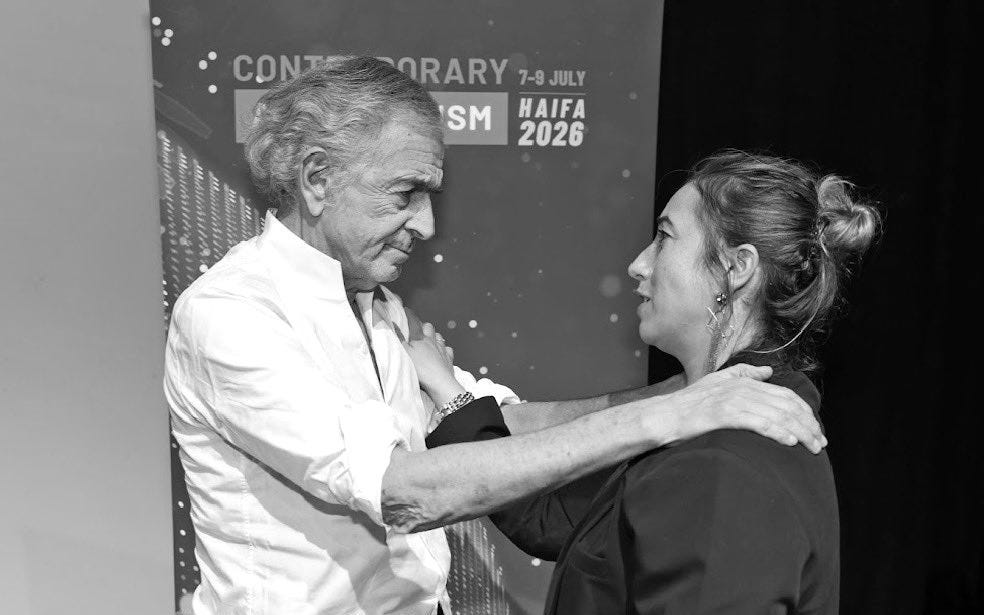
The meeting happened in person, too. After Karin’s talk I found Cochav in the crowd, and we hugged for the first time. For over two years I had cheered her on from Ohio — watching her assemble the record, posting about what she was building, understanding that one of the most important documentations of our time was taking shape in her hands.
She knew who I was; she had felt the support and understood I was tracking every step. I told Karin her talk gave me goosebumps. “Same here,” Cochav said. We had tears in our eyes, but our tears carried the opposite of grief. That is what a theory that holds can do: it gives the thing that happened to you a shape, and a name, and company. We walked out of that room empowered, both of us, and said so.
I told another colleague in Haifa that I had felt betrayed by the feminist thinkers whose books taught me how to think. The feeling came early and it came hot. What I understand now is that the only people they betrayed were themselves. The ideas belong to everyone; that was always the point. The tradition lives in whoever keeps applying it honestly — including against the institutions that claim to own it. And if anything, their disbelief should stand as the object of adjudication. Because a framework’s claim to analytical power depends on its willingness to apply that power reflexively. The testimony has been delivered — Cochav saw to that. What the framework does with it is the test.
Which is what made the company in Haifa extraordinary — the Germans and Austrians most of all. For them the “genocide” label arrives with a gift attached. Accept it, and the ledger balances: if the descendants of the victims commit the crime of the century, the descendants of the perpetrators are released from theirs. The offer stands in every faculty meeting and every feuilleton, and it costs one word. They refuse it. They come to Haifa instead and say: everyone around me is saying this, and it is wrong. They have no guarantee of jobs afterward. There may be no place for any of us inside what currently calls itself the academy. It would be so easy for them to say the easier thing and go home absolved.
An older vocabulary had a name for that courage: righteous among the nations. The term is too large for a conference room, but the shape of the courage is the same — knowing in your gut what is true and acting on it. Watching them pour each other wine, I kept thinking, “They have no idea how extraordinary they are.”
Before she slept, the woman beside me asked what I want to do when the PhD is finished. I told her the truth, which is that I have never known less. I have also never been more certain that what I am doing is exactly what I should be doing.
For years I worried about the past and holding on to the old world, the memories, my heritage. I see now that tomorrow needs the worry more. But the two feed each other — Walter Benjamin’s insight, that the past survives through a present willing to turn toward it, and the present knows itself only through what it inherits. If the past two and a half years gave one gift, it is clarity: knowing who is who, where they stand, where you belong — and staying open as the walls shift, flexible enough to evolve with them. That is the dialectic. That is critical theory, lived. Nobody can take it from us.
The torch has left the older hands. The plane began its descent toward Vienna. Beside me sat a woman my mother’s age who had learned to say Germany. Somewhere in Ohio, a girl was looking at a photograph. I sat between them, carrying the name and the ideas together.
Hours later, in Chicago, changing terminals for the last leg home, I shared a shuttle bus with a young Black couple headed to New York for the Jay-Z concert at Yankee Stadium. She was worried they’d get in too late to buy Yankees merch before the show, and I assured her she could grab a tee at LaGuardia, and she was happy. She told me she teaches fifth-grade math. I told her my son is going into fifth grade and I couldn’t do his homework if my life depended on it.
We had been talking like that a while when they asked what kind of conference I was flying home from. “Antisemitism,” I said — the whole word, out loud, in the city where the woman on the plane had once said “Germany.”
They asked what I had learned.
“We’re fucked,” I joked, and they laughed.
Then I answered honestly. “That we all need to slow down. Pause before we leap to our interpretations.”
They nodded and said how much they liked that.
The bus rolled on between terminals.
A beautiful, personal reflection!
Just amazing. It is a privilege just to know you!